


Louvre Heist: The Crime That Became a Costume

How an eight-minute theft triggered €88 million in losses, an international scandal,
and a wave of Halloween costumes.
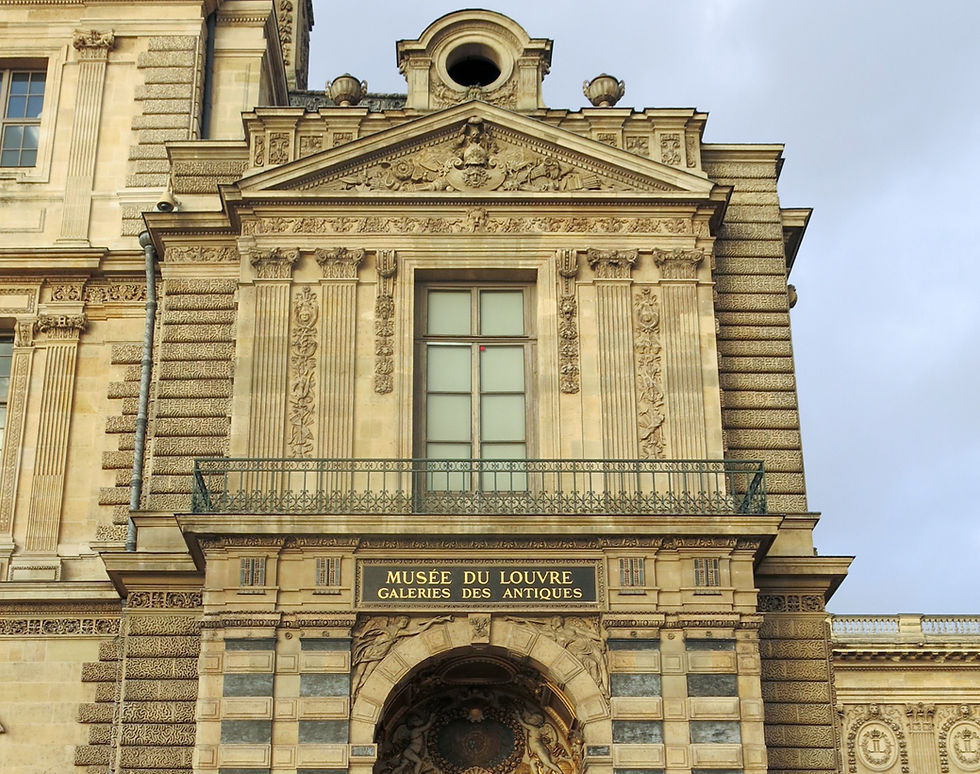
In under 8 minutes, the so-called Louvre Heist on October 19, 2025, resulted in €88 million in losses, one attempted resignation, an international scandal, and an inspiration for countless 2025 Halloween costumes. Roughly half an hour after the museum opened its doors to Sunday visitors, two men dressed as construction workers entered the Galerie d’Apollon via the Balcon de Charles IX. In high‑visibility gear that was meant to blend in but ended up being strangely eye-catching, they ascended to the balcony using a construction lift and, in under four minutes, reappeared with nine pieces of jewellery described by officials as having “immeasurable heritage value.” They rejoined two accomplices waiting at street level, then all four sped off along the Seine on two scooters, dropping the Crown of Empress Eugénie on the road as they fled.
The outline reads like a pitch for a new Hollywood blockbuster, rather than a police report. Such perception fuelled the first wave of online theories. Some even claimed it was a clever marketing idea for the new Now You See Me movie that came out in early November. Dawning over the drama of the crown falling down, it seemed only a matter of time before Netflix or some other studio would buy the rights to make it into a movie. The appeal lay in the heist’s “realness”, it seemed almost too perfectly scripted, too on‑the‑nose, for an era in which so much of life feels virtual, mediated through screens.
Like a cherry on top, Halloween came. While searching online for costume ideas, a video appeared featuring the “Robber and the Louvre Jewels” look, complete with a catchy soundtrack, a stylish font, and neatly packaged template for couples and groups. At first, the idea seemed clever, niche, almost avant‑garde. Within days, however, it became evident that this niche concept had gone mainstream, as social media feeds filled with variations on the same theme. That sudden ubiquity raised the question, what made this particular robbery so captivating? It certainly could not be the scale, since in February this year, a group of North Korean hackers managed to steal $1.5 billion from a crypto company, ByBit. It certainly also wasn’t one of a kind, when 6 years ago, a criminal group broke into the Green Vault in Dresden and also stole royal jewels. But none of them generated anything like the same cultural afterlife. While they have shaken communities related and involved, they didn’t have the scope or impact on society, in sociological terms, sparking a wave of memes, pop-culture references, and a collective myth.
Heists, AI and the hunger for “real”
One answer points less to criminology than to the technological attitudes of the mid‑2020s. As ChatGPT hit its third birthday on 30 November 2025, everyday life has become increasingly entangled with generative artificial intelligence and automation. Scholars have noted how routine digitalisation pushes fraud and crime into virtual spaces, from phishing and ransomware to deepfake‑enabled scams. In this context, the Louvre robbery offered what some internet users explicitly described as hope, a reassuringly analogue “good old heist” executed with lifts, balaclavas and power tools rather than code and malware. Media theorists have long argued that audiences periodically yearn for authenticity in response to perceived over‑mediation, and the Louvre Heist seemed to crystallise that desire in a single, dramatic narrative.
This longing for an “authentic heist” can be interpreted as a manifestation of a broader societal retreat from the inauthenticity of the digital. In economic words, this pursuit of authenticity could be correlated with the perceived value of an object. Economists and sociologists specialising in consumption have long established that authenticity functions as a “premium” attribute, especially in a market of easily reproducible digital goods. When a process or product is perceived as “real”, “original” or “hand-made”, it acquires a higher symbolic capital, which later translates into a greater cultural resonance and value. It was no different in the Louvre Heist, a crime executed with tangible, physical effort in a real setting, adding an additional cultural aspect to the situation.
Another economic narrative lies in scarcity. When digital crimes become a pervasive norm, high-stakes, physically demanding heists became highlights of previous decades, mirroring the simple economic principle: scarcity drives value.
The tangible nature of the crime provides a reassurance of presence and effort that seems to be lacking in the abstract, invisible, and personally detached nature of cybercrimes. This “realness” therefore becomes the very commodity that the public hungrily consumes, offering a temporary reprieve from the economic and social anxiety that is induced by omnipresent automation and AI, where human efforts and tangible risk are being devalued each and every day. The “virality” of the Louvre Heist can therefore be interpreted simply as the market’s response to an authentic event in a world where value is increasingly ascribed to what is truly original and real in the times of infinite digital replication.
Strip away the online myth‑making, and the suspects look far removed from the Pinterest‑ready ensembles circulating on TikTok and Instagram. Contrary to the internet’s early fantasies of a photogenic band of stylish twenty‑somethings, five individuals in their late thirties had been arrested at the time of writing, with two formally charged and three released. For now, the Louvre Heist lives in a paradoxical space, on one hand a very real crime with unresolved consequences and on another a movie-made story, endlessly envisioned into memes, costumes and posts that say as much about 2025’s anxieties about AI and authenticity as they do about the theft itself.
The jewels themselves remain considered “lost”.


Comments